

One of the most common objections pilots and operators raise when discussing fuel-saving landing procedures is the fear of accelerated brake wear. "If we land with less reverse thrust, won't our brakes wear out faster?" It's a fair question, and the answer, backed by data and airline experience, is more reassuring than you might expect.
Let's unpack the relationship between brake wear, idle reverse thrust, and carbon brakes, and show why smart use of autobrakes can let you have your fuel savings and your brake life too.
How landing procedures impact fuel efficiency: what happens after touchdown?
By the time wheels touch down, the heavy lifting of flight is over. Nevertheless, fuel efficiency doesn't end at touchdown. The way a crew manages reverse thrust, flap settings, and braking on rollout still has meaningful consequences for both fuel burn and operating costs.
Two well-known fuel optimization best practices address this phase directly:
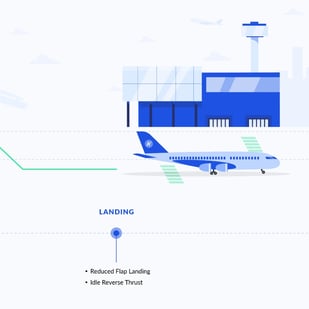
The fuel and environmental benefits are clear. Idle reverse reduces fuel burn during rollout, lowers noise, and reduces stress on the engine (fewer high-power cycles, less foreign object ingestion risk, and slower performance deterioration).
But the question that follows almost immediately is: if you're using less reverse thrust, aren't you just shifting the wear onto the brakes?
Carbon Brakes vs Steel Brakes: Why brake wear works differently.
The answer depends critically on what kind of brakes your aircraft has, and on most modern commercial aircraft, the answer is carbon brakes.
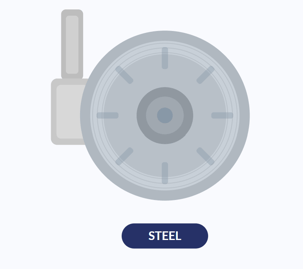
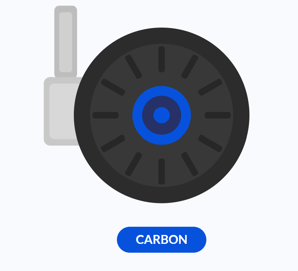
With legacy steel brakes, wear was indeed proportional to braking energy: the harder and longer you braked, the faster the pads wore down. This made a real, meaningful trade-off between reverse thrust and brake life.
Carbon brakes work differently. Wear on carbon brakes is primarily a function of the number of brake applications, not the amount of braking force applied per stop.
This fundamentally changes how we should think about the trade-off between reverse thrust and braking.
If you're using less reverse thrust, aren't you just shifting the wear onto the brakes?
With carbon brakes, shifting deceleration energy from reverse thrust to the wheel brakes — provided you do it in a controlled, consolidated way — does not necessarily accelerate brake wear in the way intuition might suggest.
In fact, The Green Airlines Fuel Book notes the finding directly from airline operational studies: brake wear in Reduced-Flap Landing and Idle Reverse operations showed negligible effect on brake life and condition on both narrow- and wide-body fleets equipped with carbon brakes.
The key to success: autobrake settings and fuel efficiency.
The caveat to everything above is how the braking is managed. Uncontrolled, reactive, or choppy braking can still result in unnecessary brake applications and create heat cycles that degrade carbon components prematurely.
This is where autobrakes become an important part of the efficiency picture.
Autobrake systems apply consistent, pre-selected braking pressure from the moment of touchdown (or wheel spinup, depending on system configuration), managing deceleration smoothly and predictably.
The message is not simply "use autobrakes", it is that autobrakes, set to the right setting for runway length, conditions, and aircraft weight, allow crews to maximize the fuel and noise benefits of Idle Reverse while keeping brake wear well within acceptable bounds.
Airlines that have studied this combination consistently report that proper autobrake use in Idle Reverse operations adds no meaningful brake wear penalty. The brake cycle count (what actually drives carbon brake life) is no higher than in conventional operations.
How to track brake wear and landing performance with data.
For airlines serious about managing brake life alongside fuel efficiency, the answer lies in data. Modern aircraft generate enough information to track brake cycle counts, temperature profiles, and wear rates at the individual aircraft and route level.
A mature fuel management information system like SkyBreathe® can correlate operational events — including landing procedures, reverse thrust usage, and autobrake settings — with maintenance outcomes over time. This makes it possible to validate, using actual fleet data, that Idle Reverse and Reduced Flap operations do not accelerate brake replacement cycles — and to catch any exceptions early if they arise.
The principle here is the same one that runs throughout the field of fuel efficiency: you cannot improve what you do not measure. Brake wear is no different. Once you have visibility into what is actually driving replacement cycles across your fleet, the fear of "ruining your brakes to save fuel" gives way to evidence-based confidence.
Does Idle Reverse Thrust really cause brake wear?
The verdict.
The concern that Idle Reverse Thrust accelerates brake wear is understandable; it makes intuitive sense that "something has to absorb the energy." But on modern aircraft with carbon brake systems and properly configured autobrakes, the data simply does not support that concern.
What it does support is a landing procedure stack that saves fuel, reduces noise, preserves engine life, and keeps brake wear within normal bounds — all at the same time. That is not a trade-off. That is good operations optimization.
If your airline is not yet systematically tracking landing best-practice application rates — including Idle Reverse, Reduced Flap, and autobrake selection — SkyBreathe® can give you the visibility to get started. Because the savings are there on every single arrival. You just have to land them.
Ready to replace the fear of brake wear with real fleet data?
SkyBreathe® tracks your landing procedures so you can optimize with confidence. Let's talk.

GOING FURTHER: The Landing best practices stack.
A fuel-efficient landing is not a single technique but a combination of practices that reinforce one another. Each of these practices is beneficial in its own right. Together, they produce a landing and rollout sequence that is significantly leaner in fuel and emissions, without trading away aircraft serviceability.
| Phase | Best Practice & Resources | Benefit |
| Final approach | Low Power Low Drag | Reduced drag, fuel burn, and noise |
| Landing configuration | Reduced Flap Landing | Less drag, lower fuel burn, reduced noise near airport |
| Rollout | Idle Reverse Thrust | Lower fuel burn, noise, engine wear |
| Deceleration | Proper Autobrake selection | Consolidated braking, negligible carbon brake wear impact |
| Taxi-in | Engine-Out Taxi-In (EOTI) | Fuel savings of tens of kg per arrival |


