---
title: "Rising jet fuel prices: airline survival or strategy?| OpenAirlines"
description: Jet fuel price spike is reshaping airlines' strategy | See how rising fuel costs impact airlines' profitability, fares, and operations in 2026
image: https://blog.openairlines.com/hubfs/Blog-illustration/Blog%20header%20-%20The%20rising%20of%20jet%20fuel%20prices.jpg
---
[](https://www.openairlines.com/)
- [Home](https://www.openairlines.com/)
- 360° eco-flying platform
- [SkyBreathe® Analytics – Fuel management software](https://www.openairlines.com/fuel-management-software/)
- [+ Emissions Report module](https://www.openairlines.com/fuel-management-software/report-co2-emissions/)
- [+ Advanced Trajectory module](https://www.openairlines.com/fuel-management-software/advanced-trajectory-module/)
- [SkyBreathe® MyFuelCoach – Pilot engagement app](https://www.openairlines.com/pilot-engagement-app/)
- [SkyBreathe® OnBoard – Real-time eco-flying app](https://www.openairlines.com/real-time-eco-flying-app/)
- [SkyBreathe® APM – Aircraft Performance Monitoring](https://www.openairlines.com/aircraft-performance-monitoring/)
- [SkyBreathe® OTP – On-time performance analysis](https://www.openairlines.com/on-time-performance-analysis/)
- Use Cases
- [SkyBreathe For CEO/CFO](https://www.openairlines.com/for-ceo-cfo/)
- [SkyBreathe For Head of Flights Ops & Chief Pilot](https://www.openairlines.com/for-head-of-flights-ops-chief-pilot/)
- [SkyBreathe For Pilots](https://www.openairlines.com/for-pilots/)
- [SkyBreathe For Fuel Managers & Ops Engineers](https://www.openairlines.com/for-fuel-managers-ops-engineers/)
- [Customers Stories](https://www.openairlines.com/customers/)
- Resources
- [Blog](https://blog.openairlines.com/)
- [White Papers](https://blog.openairlines.com/tag/white-paper)
- [Case Studies](https://blog.openairlines.com/tag/case-studies)
- [Webinars on fuel efficiency](https://blog.openairlines.com/tag/upcoming-webinars)
- [Upcoming Tradeshows](https://blog.openairlines.com/tag/tradeshow)
- [OpenAirlines Academy](https://academy.openairlines.com/?utm_campaign=23545222-Academy&utm_source=FuelEfficiencyBlog)
- Company
- [OpenAirlines Mission](https://www.openairlines.com/our-company/)
- [News](https://blog.openairlines.com/news)
- [Career - We are Hiring!](https://www.welcometothejungle.com/fr/companies/openairlines)
- [Sustainability Report](https://www.openairlines.com/sustainability-report/)
- [OpenDay](https://info.openairlines.com/openday2026)
- [Contact](https://www.openairlines.com/contact/)
[](https://cta-redirect.hubspot.com/cta/redirect/4233951/5390e83d-eea4-4183-83a3-0f26b0324d37)
##### Blog
- [Latest articles](https://blog.openairlines.com)
- [Fuel Efficiency](https://blog.openairlines.com/tag/fuel-efficiency)
- [Airline Experience](https://blog.openairlines.com/tag/airline-experience)
- [Sustainability](https://blog.openairlines.com/tag/environment)
- [Technology](https://blog.openairlines.com/tag/technology)
- [News](https://blog.openairlines.com/news)
[Back to Blog](https://blog.openairlines.com)
# The rising of jet fuel prices: airline survival or strategy?
Published by [OpenAirlines](https://blog.openairlines.com/author/openairlines) on May 13, 2026, 11:52:48 AM
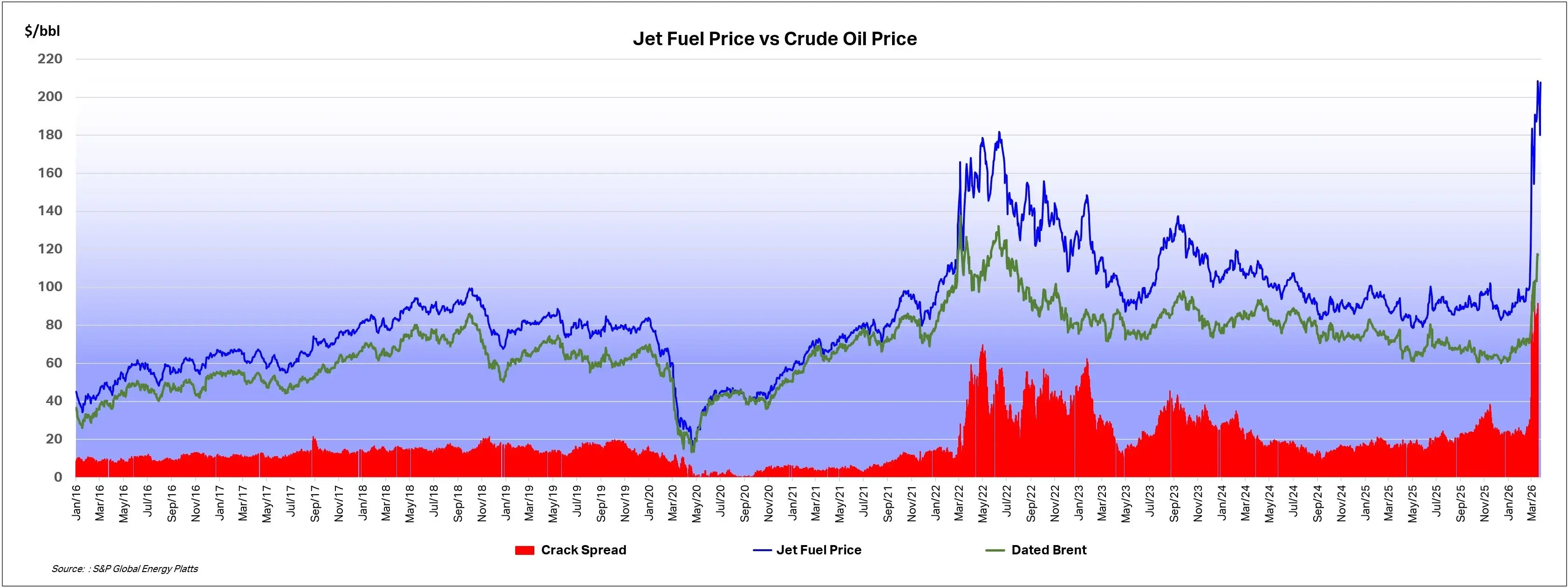
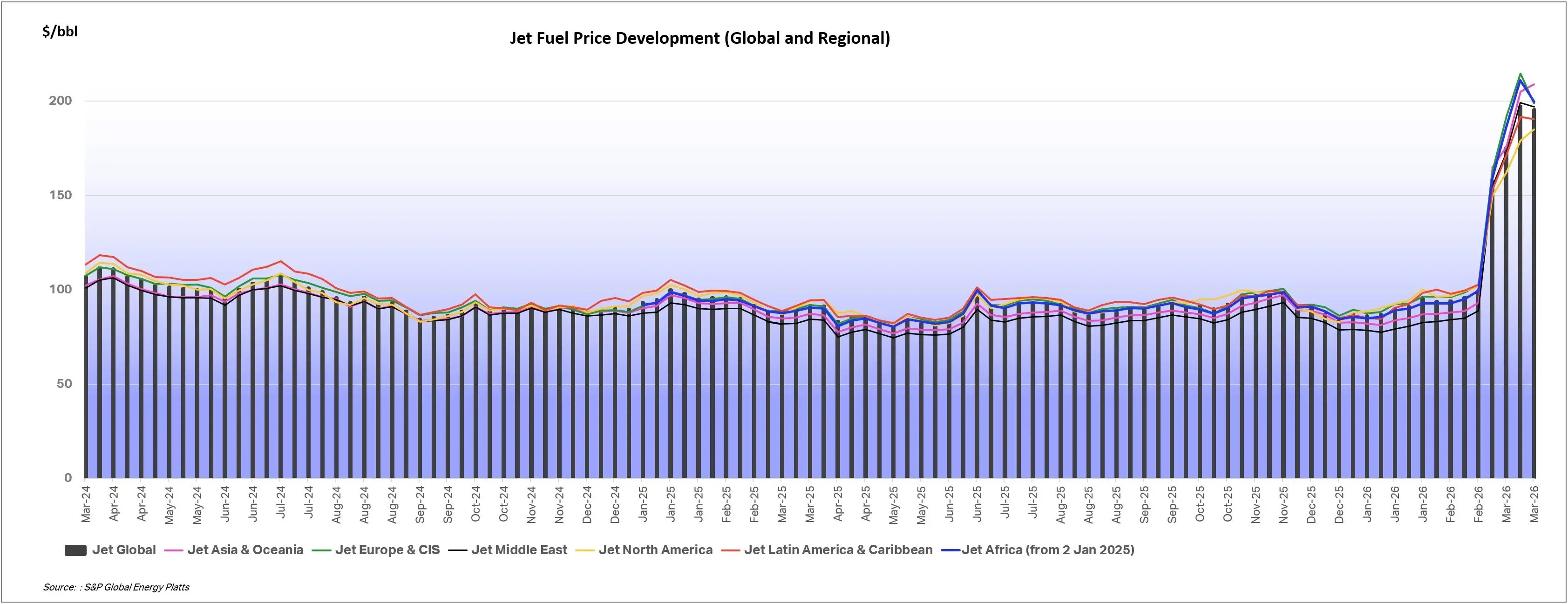
What happens when Jet **Fuel** pushes past the $100, $150, $200 per barrel range? It’s not a hypothetical that airlines can ignore. In a market shaped by geopolitical uncertainty, **sudden price spikes remain a real and recurring risk**—one that can rapidly expand operating costs and put immediate pressure on margins.
 [Source: S&P Global Energy Platts](https://www.iata.org/en/publications/economics/fuel-monitor/?gad_source=1&gad_campaignid=23170356602&gbraid=0AAAAAD5_atfwuoxjdz1N8JSn3RiAVjbDU&gclid=CjwKCAjwvqjOBhAGEiwAngeQna_rlMUNJsk9ePD4yochaSWQLpaydJcbmHmbfs9gGC6lAgCqPsPw9xoCn1IQAvD_BwE)
[IATA's Jet Fuel Price Monitor](https://www.iata.org/en/publications/economics/fuel-monitor/?gad_source=1&gad_campaignid=23170356602&gbraid=0AAAAAD5_atfwuoxjdz1N8JSn3RiAVjbDU&gclid=CjwKCAjwvqjOBhAGEiwAngeQna_rlMUNJsk9ePD4yochaSWQLpaydJcbmHmbfs9gGC6lAgCqPsPw9xoCn1IQAvD_BwE)
When oil and jet fuel prices move as quickly as they have these weeks, traditional "waiting it out" may not be an option. For major carriers, this could represent an additional $ 2 billion or more in annual fuel expenses, a shock that tests the limits of even the most resilient balance sheets.
## A legacy of adaptation in the airline industry
Across multiple fuel price cycles, **airlines** have proven they can endure. We’ve seen a consistent, disciplined pattern of recovery. Airlines typically respond to fuel price shocks through a combination of financial agility, risk management, operational discipline, and structural evolution.
Airlines have survived these surcharges because they are built to adapt.
[Source: S&P Global Energy Platts IATA's Jet Fuel Price Monitor](https://www.iata.org/en/publications/economics/fuel-monitor/?gad_source=1&gad_campaignid=23170356602&gbraid=0AAAAAD5_atfwuoxjdz1N8JSn3RiAVjbDU&gclid=CjwKCAjwvqjOBhAGEiwAngeQna_rlMUNJsk9ePD4yochaSWQLpaydJcbmHmbfs9gGC6lAgCqPsPw9xoCn1IQAvD_BwE)
## The real impact of rising jet fuel prices on airlines
But a price surge of this magnitude forces immediate, difficult choices:
- Workforce adjustments : Labor is a cost lever. However, reducing headcount carries long-term risks, including the loss of critical expertise and reduced operational resilience.
- Airfares vs. Demand : Airlines could [raise ticket prices](https://www.businessinsider.com/what-airline-ceos-are-saying-iran-war-impact-flights-prices-2026-3?) to cover costs, but they risk hitting a "ceiling" where travelers simply stop booking. Indeed, as of today, numerous airlines, including Cathay Pacific, Air New Zealand, and SAS, have mentioned a possible [ticket price increase to mitigate the effects of the oil price surge.](https://www.channelnewsasia.com/world/iran-war-price-hikes-outlook-cuts-what-airlines-are-doing-fuel-costs-surge-5983921?)
- [The Hedging Gap](https://blog.openairlines.com/airline-strategies-for-mitigating-high-jet-fuel-costs): While some global carriers use financial hedges to cushion the blow, many, particularly in the US, are fully exposed to the spot market.
- The Efficiency Mandate : When fuel cost is higher than expected, every minute of unnecessary taxing or every suboptimal flight path isn't just "waste", it’s a direct hit to the airline’s survival.
These levers are effective, but not always sufficient, especially when volatility persists. Today’s "New Era of Uncertainty" is urging industry to **move from reactive adaptation to systematic efficiency.**
> \>\>\> [United CEO said the company is preparing for a prolonged period of elevated fuel prices, modeling oil at $175 per barrel and expecting it could remain above $100 through the end of 2027.](https://nypost.com/2026/03/21/lifestyle/united-airlines-slashes-flights-as-iran-war-sends-fuel-prices-soaring/)
## Turning the tide with data & fuel efficiency
In a **market** this volatile, information becomes one of the most reliable ways to manage exposure.
> [\>\>\> "Greater fuel efficiency is a clear advantage as airlines' largest expense after labor is jet fuel."](https://www.reuters.com/business/ultra-low-cost-airlines-made-risky-bet-fuel-efficient-planes-2026-03-20/)
> -Reuters
Historically, **airlines** approached fuel efficiency in a fragmented, reactive way, intensifying efforts when oil and fuel prices rose and scaling them back when prices fell.
Today, leading companies are moving beyond this cycle. Instead of only reacting to jet fuel price surcharges, they are adopting a systematic, data-driven approach to actively reduce their exposure.
Platforms like [SkyBreathe® by OpenAirlines](https://www.openairlines.com/fuel-management-software/) enable flight operators to anticipate and respond more effectively to fuel scenarios. These solutions provide real-time, actionable insights that enable smarter operational decisions. For example, with SkyBreathe®, airlines can:
| **Identify "hidden" savings**: Pinpointing exactly where fuel is being wasted in real-time across the entire fleet. | **Standardize excellence:** Turning proven fuel-savings practices into consistent performance across the fleet. | **Engage the cockpit:** Inviting every pilot to be a stakeholder in the airline’s economic resilience through personalized feedback. |
| --- | --- | --- |
## The bottom line: strategy over survival
Historically, the aviation industry has proven its ability to endure oil price fares. But endurance alone isn't a strategy. **As fuel costs reach historic highs**, the winners will be those who move beyond reactive measures and embrace systematic, data-driven efficiency.
Ready to turn volatility into a competitive advantage?
Don't just endure the spikes. Control your exposure to them.
The most resilient flight companies don't wait for fuel prices to drop; they build systems, practices, and procedures that thrive regardless of the market. Discover how SkyBreathe® and the OpenAirlines team provide the data-driven insights your team needs to reduce fuel burn, engage your pilots, and protect your bottom line.
[](https://blog.openairlines.com/hs/cta/wi/redirect?encryptedPayload=AVxigLI02wzxNY4Kx63shFAgSSetCReJenCybA4sYUixo5JQuT%2BNW6ThlhtXOmAzoyU1v8dM8BsDeLrHg1C85XvQbrW9ehCafERWWi3GyuQzh0zXF47foGnPKQcRO6o%2FNu3ONo3Vn2VvH59N%2BaLb8TOC5MUnWhTPcS9Fb9vrpvhbSDehVmIcdgIfscOtAcqllMqaCebGwGM3VI%2BTC9AcUijxujmDCQrNFR%2Bz8RMzV%2F60qwxJ5RA%3D&webInteractiveContentId=210187367978&portalId=4233951)
| **About the author:** **** William (Will) Jiménez is Director of Sales, Americas at OpenAirlines, where he helps airlines cut fuel costs and advance sustainability through AI-driven operational efficiency. With over 15 years of experience in aviation technology, spanning pricing, fleet analysis, and large-scale airline data platforms at IATA, IBA, and Infare, he partners with CFOs, COOs, and flight operations leaders to deliver 2–5% fuel-burn reductions, rapid ROI, and long-term SAF readiness. |
| --- |
## Frequently asked questions:
What is causing the current aviation fuel increase?
The current **jet fuel spike** is driven by a combination of geopolitical tensions, supply disruptions, and refining capacity constraints. These factors are pushing up crude oil prices while also tightening jet fuel supply, leading to sharper cost increases for airlines.
How does a jet fuel spike impact airlines?
A **fuel increase** directly affects airline profitability because fuel is one of the largest operating expenses (up to 30%). Higher fuel costs force airlines to:
1. Raise ticket prices
2. Reduce capacity or routes
3. Optimize operations even further
4. Reassess financial strategies
[Price hikes, outlook cuts: What airlines are doing as fuel costs surge](https://www.channelnewsasia.com/world/iran-war-price-hikes-outlook-cuts-what-airlines-are-doing-fuel-costs-surge-5983921?)
Is the aviation fuel price spike expected to continue?
While fuel prices are inherently volatile, current market conditions suggest that **aviation fuel prices may remain elevated** due to ongoing geopolitical uncertainty and structural supply constraints. Airlines are therefore shifting toward long-term strategies rather than temporary fixes.
[What the CEOs of the 3 biggest US airlines are saying about the Iran war's hit to travel and ticket prices](https://www.businessinsider.com/what-airline-ceos-are-saying-iran-war-impact-flights-prices-2026-3?)
How important is fuel efficiency during an aviation fuel increase?
Fuel efficiency becomes critical amid rising **aviation fuel prices**, as even small improvements can yield significant cost savings at scale. With fuel representing a major share of operating expenses, airlines that optimize fuel consumption can better protect their margins.
Improving fuel efficiency involves:
- Optimizing flight paths and altitude
- Reducing aircraft weight and taxi time
- Using real-time data to adjust operations
- Engaging pilots in fuel-saving practices
Solutions like those developed by OpenAirlines enable airlines to systematically reduce fuel burn and turn efficiency into a long-term competitive advantage.
Tags: [Fuel efficiency](https://blog.openairlines.com/tag/fuel-efficiency), [Fuel program](https://blog.openairlines.com/tag/fuel-program)
[Back to Blog](https://blog.openairlines.com)
[](http://www.facebook.com/share.php?u=https://blog.openairlines.com/rising-jet-prices-airlines-strategy&utm_medium=social&utm_source=facebook) [](https://twitter.com/intent/tweet?original_referer=https://blog.openairlines.com/rising-jet-prices-airlines-strategy&utm_medium=social&utm_source=twitter&url=https://blog.openairlines.com/rising-jet-prices-airlines-strategy&utm_medium=social&utm_source=twitter&source=tweetbutton&text=) [](http://www.instagram.com/share.php?u=https://blog.openairlines.com/rising-jet-prices-airlines-strategy&utm_medium=social&utm_source=instagram) [](http://www.linkedin.com/shareArticle?mini=true&url=https://blog.openairlines.com/rising-jet-prices-airlines-strategy&utm_medium=social&utm_source=linkedin) [](https://web.whatsapp.com)
## Related Articles
## [\[Report\] Must-know airline fuel efficiency trends](https://blog.openairlines.com/must-know-airline-fuel-efficiency-trends)
Fuel costs keep rising, and carbon pricing keeps tightening. The good news: many airlines are...
[Read More](https://blog.openairlines.com/must-know-airline-fuel-efficiency-trends)
## [\[White paper\] Operational efficiency: stabilizing fuel economics in a SAF-driven future](https://blog.openairlines.com/white-paper-operational-efficiency-stabilizing-fuel-economics-in-a-saf-driven-future)
Why saving fuel today protects your margins tomorrow As the aviation industry moves toward...
[Read More](https://blog.openairlines.com/white-paper-operational-efficiency-stabilizing-fuel-economics-in-a-saf-driven-future)
## [\[Webinar\] Pegasus' fuel efficiency solution implementation experience](https://blog.openairlines.com/webinar-how-pegasus-airlines-quickly-implemented-a-fuel-efficiency-solution-to-transform-its-flight-operations)
Are you curious about how leading airlines are adopting innovative strategies to enhance...
[Read More](https://blog.openairlines.com/webinar-how-pegasus-airlines-quickly-implemented-a-fuel-efficiency-solution-to-transform-its-flight-operations)
[](https://www.openairlines.com/)
EUROPE - HEADQUARTERS
31, rue Alsace Lorraine – 31000 Toulouse, France
ASIA
10 Floor, Guangdong Investement Tower
148 Connaught Road Central, Hong Kong
AMERICAS
c/o Jade Fiducial 990 Biscayne Blvd Office
701 Miami, FL33132 USA
- SkyBreathe® Platform
- [SkyBreathe® Analytics – Fuel management software](https://www.openairlines.com/fuel-management-software/)
- [SkyBreathe® MyFuelCoach – Pilot engagement app](https://www.openairlines.com/pilot-engagement-app/)
- [SkyBreathe® OnBoard – Real-time eco-flying app](https://www.openairlines.com/real-time-eco-flying-app/)
- [SkyBreathe® APM – Aircraft Performance Monitoring](https://www.openairlines.com/aircraft-performance-monitoring/)
- [SkyBreathe® OTP – On-time performance analysis](https://www.openairlines.com/on-time-performance-analysis/)
- Use Cases
- [SkyBreathe® For CEO/CFO](https://www.openairlines.com/for-ceo-cfo/)
- [SkyBreathe® For Head of Flights Ops & Chief Pilot](https://www.openairlines.com/for-head-of-flights-ops-chief-pilot/)
- [For Fuel Managers & Operations Engineers](https://www.openairlines.com/for-fuel-managers-ops-engineers/)
- [SkyBreathe® For Pilots](https://www.openairlines.com/for-pilots/)
- [Customers Stories](https://www.openairlines.com/customers/)
- [Our Company](https://www.openairlines.com/our-company/)
- [Sustainability Report](https://www.openairlines.com/sustainability-report/)
- [Career](https://www.welcometothejungle.com/fr/companies/openairlines)
- [Contact](https://www.openairlines.com/contact/)
- Resources
- [Blog](https://blog.openairlines.com/)
- [White papers](https://blog.openairlines.com/tag/white-paper)
- [Case Studies](https://blog.openairlines.com/tag/case-studies)
- EVENTS
- [OpenDay](https://info.openairlines.com/openday)
- [Upcoming Webinars](https://blog.openairlines.com/tag/upcoming-webinars)
- [Upcoming Trade Shows](https://blog.openairlines.com/tag/tradeshow)
### © Openairlines 2023 - All Rights Reserved
- [Privacy Policy](https://www.openairlines.com/privacy-policy/)
- [Cookies Policy](https://www.openairlines.com/cookies-policy/)
- [Site Map](https://www.openairlines.com/site-map/)
```json
{
"@context" : "https://schema.org",
"@type" : "BlogPosting",
"author" : {
"@type" : "Person",
"name" : "OpenAirlines",
"url" : "https://blog.openairlines.com/author/openairlines"
},
"dateModified" : "2026-05-13T10:09:23.380Z",
"datePublished" : "2026-05-13T09:52:48.000Z",
"headline" : "Rising jet fuel prices: airline survival or strategy?",
"image" : [ "https://blog.openairlines.com/hubfs/Blog-illustration/Blog%20header%20-%20The%20rising%20of%20jet%20fuel%20prices.jpg" ],
"mainEntityOfPage" : {
"@id" : "https://blog.openairlines.com/rising-jet-prices-airlines-strategy",
"@type" : "WebPage"
},
"publisher" : {
"@type" : "Organization",
"logo" : {
"@type" : "ImageObject",
"url" : "https://blog.openairlines.com/hubfs/Blog-illustration/Logo.png"
},
"name" : "Nextops OpenAirlines"
}
}
```